

Finding water in my basement is one of those home problems that’s difficult to ignore. Maybe you discovered a small puddle after a Kentucky rainstorm. Perhaps water is seeping through a foundation crack, appearing where the wall meets the floor, or leaving damp spots and stains across your basement walls. In more serious situations, you may be dealing with standing water throughout the basement.
Whatever the situation looks like, water doesn’t belong in your basement.
Basements have extensive contact with the surrounding soil, which makes foundations particularly vulnerable to rainwater, groundwater, and other sources of moisture. The EPA identifies rain-soaked soil, high water tables, plumbing leaks, and condensation as potential contributors to foundation moisture problems.
If you’ve been searching “water in my basement” because you’re trying to figure out where it came from and what to do next, the most important step is determining the source.
BDry of Kentucky provides professional basement waterproofing services throughout Central, Southern, and Eastern Kentucky. BDry’s waterproofing system is designed to manage several common pathways through which groundwater can enter basements and crawlspaces.
Here’s what every homeowner should know when they’re searching “water in my basement.”
Why Is There Water In My Basement?
Water can reach a basement in several ways, and the location of the puddle doesn’t always tell you exactly where the problem began.
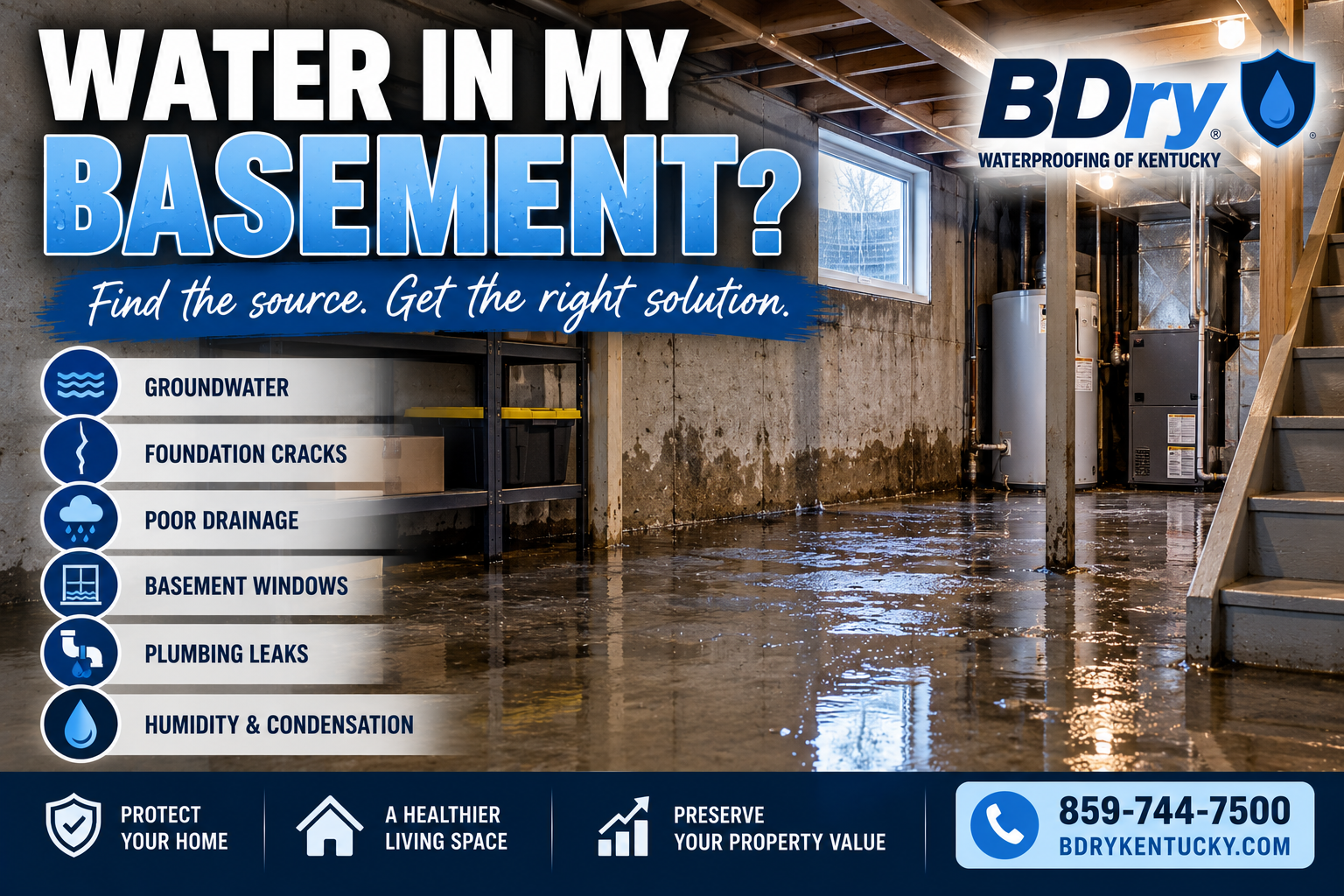
Common sources include:
- Groundwater surrounding the foundation
- Water moving over or underneath the foundation footing
- Foundation wall cracks
- The joint between the basement wall and floor
- Floor cracks
- Poor exterior drainage
- Improper grading
- Basement windows or window wells
- Plumbing leaks
- Excessive humidity and condensation
According to the U.S. Geological Survey, some precipitation infiltrates the ground and then moves vertically and horizontally through soil and other subsurface materials.
For a basement surrounded by increasingly wet soil, that groundwater needs somewhere to go.
If the home’s drainage system cannot adequately manage it, vulnerable areas in and around the foundation may provide a pathway into the basement.
1. Groundwater May Be Causing Water In My Basement
Groundwater is one of the first things to consider when water appears during or following significant rainfall.
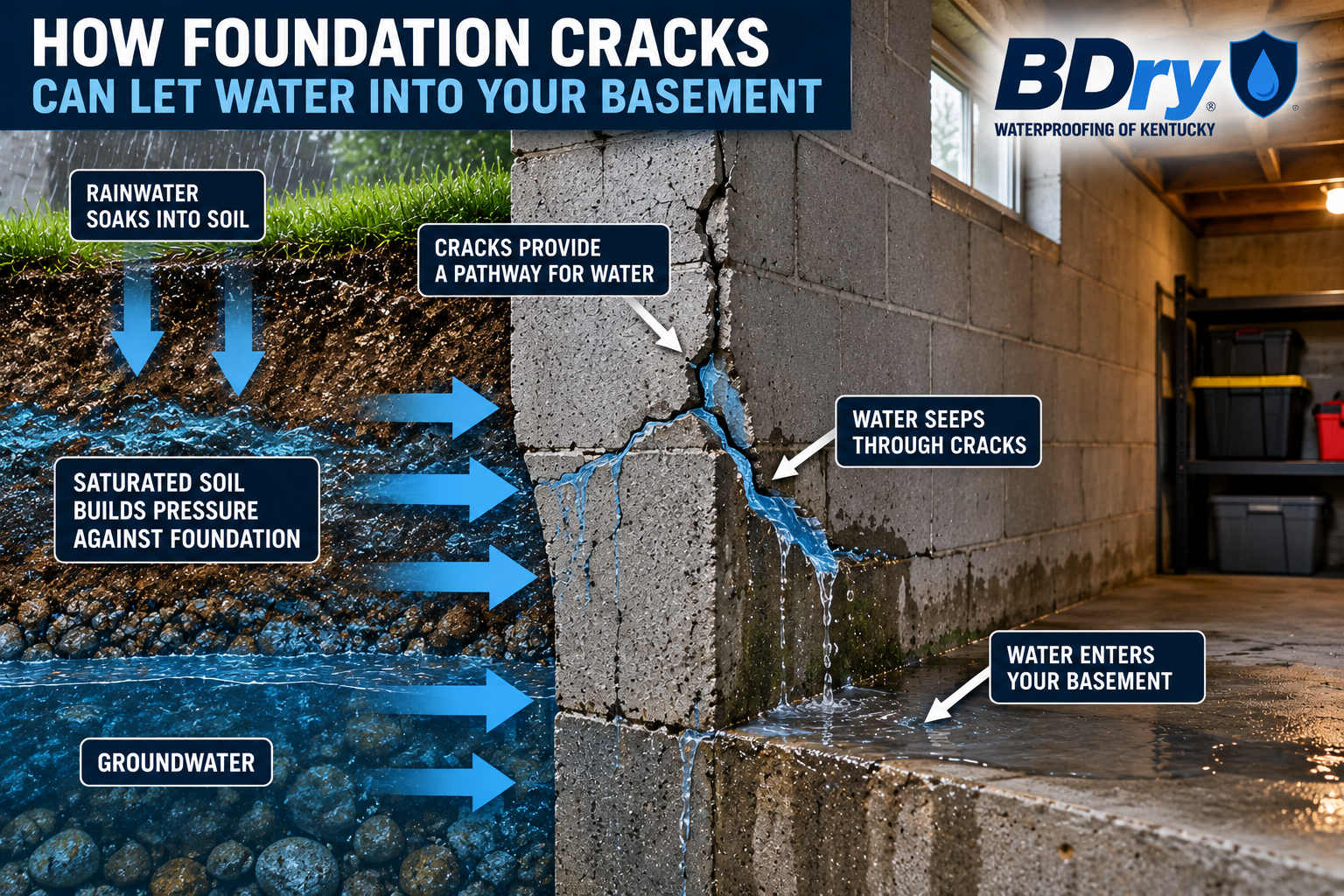
As rain enters the soil, the ground around your foundation can become saturated. If groundwater levels rise, water can accumulate around and beneath the foundation.
BDry explains that when an original builder-installed French drain becomes inadequate or fails, groundwater can travel over or underneath the footing. BDry’s High-Capacity Drain System is designed to capture this water and direct it into the waterproofing system.
You may be dealing with groundwater if:
- Water appears primarily after heavy rain
- The basement stays dry during extended dry weather
- Water appears around the basement perimeter
- You find water at the wall-floor joint
- Water seems to be coming from beneath the floor
- Several areas become wet simultaneously
This is one reason simply wiping up the puddle won’t solve the underlying problem.
The water you’re seeing may be the final stage of a larger groundwater problem occurring beneath and around your house.
2. Foundation Cracks Can Provide a Pathway for Water In My Basement
Concrete is extremely strong, but foundations can still develop cracks.
Some foundation cracks remain dry. Others can become pathways for water when the soil surrounding the basement becomes saturated.
Signs that a crack may be contributing to water in my basement include:
- Visible water running from the crack
- Dampness immediately surrounding it
- Water stains beneath the crack
- White or chalky mineral deposits
- A leak that returns in the same location whenever it rains
BDry’s system uses engineered weep holes to direct certain wall seepage into its drainage pipe, while the company’s wall system directs excess moisture toward the drainage system.
It’s important to distinguish water intrusion from a structural foundation problem. BDry’s website directs homeowners who need structural foundation repair to its affiliate, Ram Jack of Kentucky.
3. Poor Exterior Drainage May Be Sending Water Toward Your Foundation
Sometimes the explanation for water in my basement starts outside.
Your roof collects an enormous amount of rainwater during a storm. Gutters and downspouts are supposed to move that water away from the foundation.
Problems can arise when:
- Gutters are clogged
- Gutters overflow
- Downspouts empty beside the house
- Landscaping directs water toward the foundation
- Low spots allow water to pool
- The ground slopes toward the house
The EPA recommends repairing leaks and seepage and ensuring the ground slopes away from the house. It specifically notes that basement water can result from inadequate gutters or water flowing toward a house.
The EPA also advises maintaining gutters and preventing water from collecting around the foundation.
During the next significant rain, safely observe what’s happening around your home.
Where does the water go?
If you see water pouring over gutters or pooling against the foundation, exterior drainage deserves attention.
4. Water Can Appear Where the Wall Meets the Basement Floor
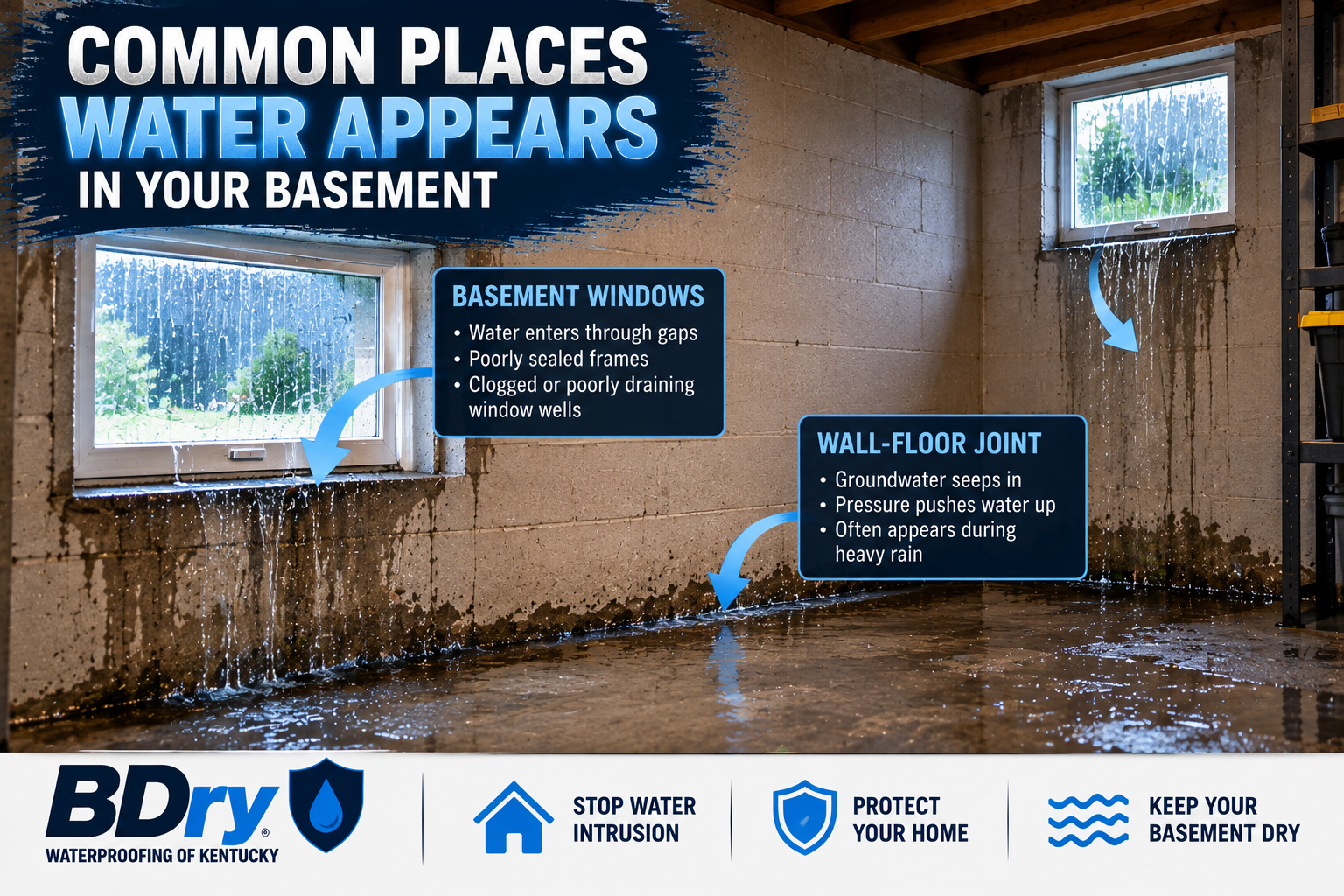
One particularly confusing problem is water appearing along the perimeter of a basement where the wall meets the floor.
It may look like the bottom of the wall is leaking, but the water could actually be traveling around or beneath the foundation footing before appearing at the wall-floor joint.
That’s an important distinction.
Simply applying sealant along the visible wet area doesn’t necessarily manage the groundwater responsible for the leak.
BDry’s waterproofing system is specifically designed to capture groundwater at critical entry points and direct it through a high-capacity drainage system.
Professional waterproofing is therefore about more than covering the place where water appears. It’s about understanding how there is water in my basement and controlling where it goes next.
5. Basement Windows Can Leak Water In My Basement
Don’t forget to look up.
Basement windows and window wells can become another source of water intrusion during heavy rain.
Watch for:
- Water accumulating in the window well
- Water stains beneath the window
- Wet walls immediately below the window
- Failed seals
- Damaged frames
- Poor drainage around the window
- Landscaping directing runoff toward the well
If the water consistently begins near a basement window, the window and surrounding exterior drainage should be investigated.
The same principle applies here: find the source of the water in my basement rather than repeatedly cleaning up the symptom.
Is It Actually Water Intrusion or Condensation?
Not every damp basement is experiencing groundwater intrusion.
Sometimes what looks like a leak is condensation.
The EPA explains that as air temperature decreases, it can hold less moisture. Moisture can consequently condense on colder surfaces.
Basements are often cooler than the rest of the house, making condensation possible when warm, humid air reaches cold walls, pipes, windows, or other surfaces.
Signs of a humidity or condensation problem may include:
- Moisture covering a broad area
- Sweating pipes
- Condensation on windows
- Damp walls without an obvious entry point
- High relative humidity
- Dampness occurring even when it hasn’t rained
The EPA recommends keeping indoor relative humidity below 60%, ideally between 30% and 50% when possible.
BDry installs commercial-grade dehumidifiers for basements and crawlspaces where excessive humidity is contributing to moisture problems.
However, a dehumidifier isn’t designed to repair active groundwater intrusion. That’s why distinguishing between humidity and a leak is so important when there is water in my basement.
Why Water In My Basement Shouldn’t Be Ignored
It’s tempting to treat a small basement leak as nothing more than an inconvenience.
Put down a towel. Run a fan. Move a few boxes.
Problem solved—until the next storm.
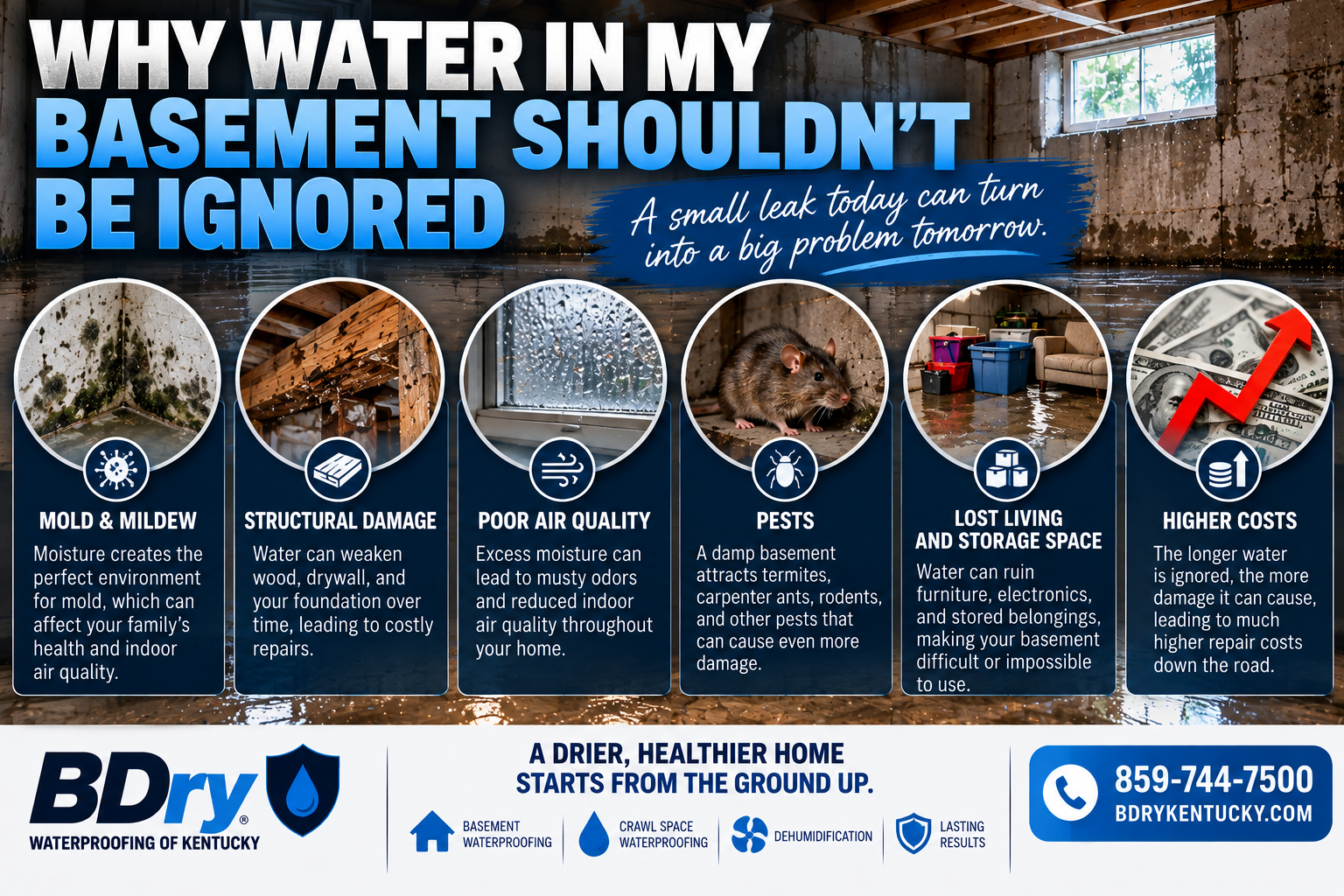
Recurring moisture can affect materials throughout the basement and make the space difficult to use confidently.
Mold and Mildew
Moisture is fundamental to mold growth.
The EPA describes moisture control as the key to mold control and recommends drying wet or damp materials quickly after leaks or spills.
Damaged Building Materials
Repeated exposure to moisture can affect:
- Drywall
- Flooring
- Insulation
- Wood
- Furniture
- Stored belongings
- Finished basement materials
If you’re planning to remodel or finish the basement, solving the moisture problem should come first.
The EPA specifically recommends checking basements for leaks and other signs of moisture before converting them into living areas because damp basements can promote biological growth, including mold.
Lost Living and Storage Space
A basement represents valuable square footage.
But if you’re afraid to put furniture, electronics, family keepsakes, or storage boxes downstairs because the next storm might flood them, that space becomes much less useful.
Solving the underlying moisture problem can help you use your basement with greater confidence.
What Should I Do When I Find Water In My Basement?
If you’ve just discovered water, start with safety.
Significant flooding around electrical equipment, outlets, appliances, or wiring can present hazards. Avoid entering standing water when electrical hazards may be present and seek appropriate professional assistance.
Once it’s safe to investigate, look for clues.
Ask yourself:
Where did the water first appear?
Is there a visible foundation crack?
Is water entering near a window?
Is the entire wall damp or only one area?
Are gutters overflowing outside?
Does the ground slope toward the house?
Is the water appearing even during dry weather?
Could a plumbing fixture or pipe be leaking?
Take photographs and document where the water appears. Those details can be useful during a professional basement inspection.
Why DIY Waterproofing May Not Fix Water In My Basement
When homeowners find water downstairs, waterproof paint, caulk, hydraulic cement, or crack filler can seem like an inexpensive solution.
But there’s an important question:
What caused the water to reach that location in the first place?
If groundwater is accumulating around your foundation, covering the visible wet spot doesn’t necessarily eliminate that groundwater.
Professional basement waterproofing approaches the problem differently.
Instead of asking only, “How do we cover this leak?”, the investigation should determine:
- Where the water originates
- How it reaches the foundation
- Where it enters the basement
- How it can be captured
- How it should be redirected
- Where it can safely discharge
A lasting waterproofing strategy is about water management, not simply hiding evidence of moisture.
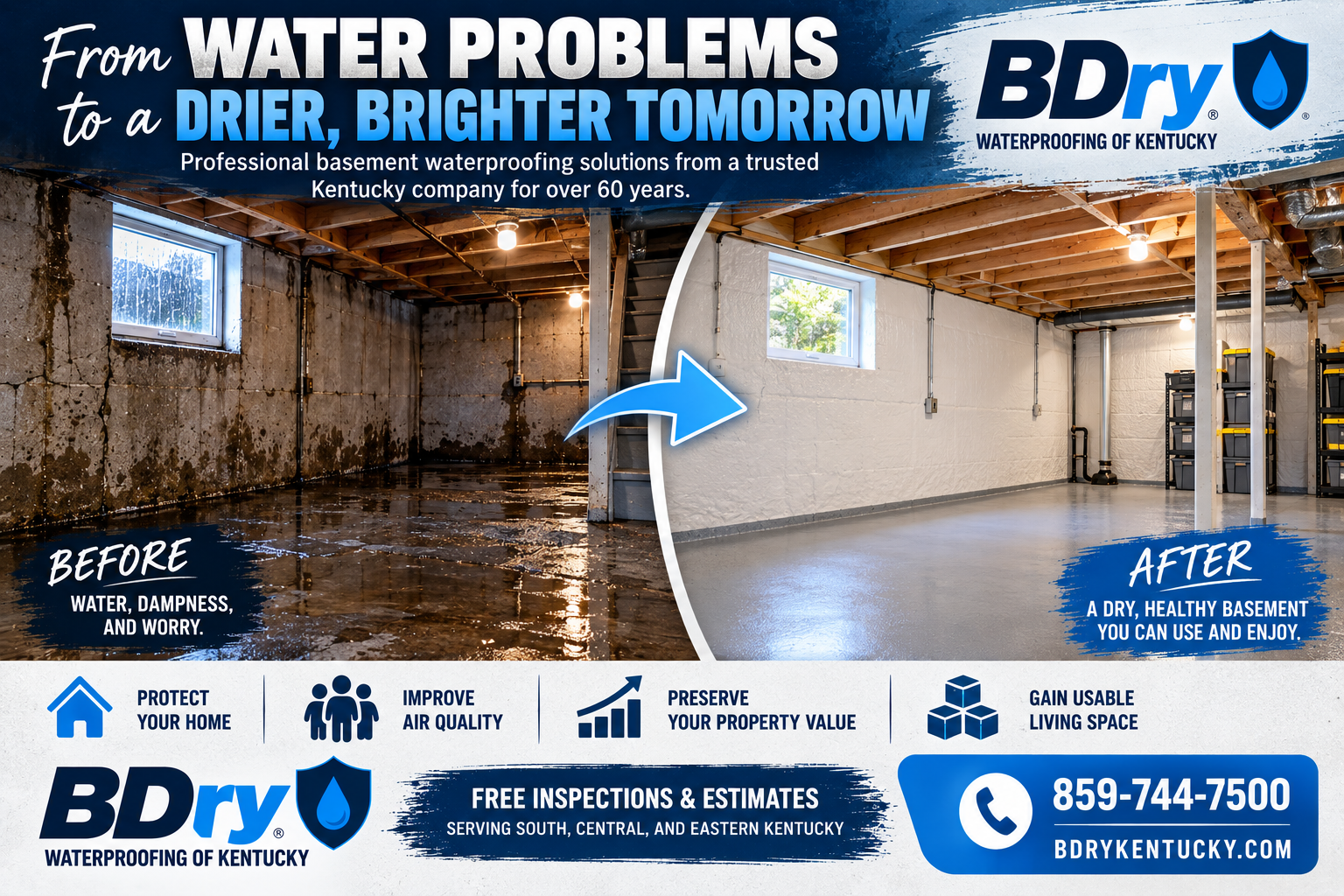
How Professional Basement Waterproofing Works
Every basement is different, which means there isn’t one identical solution for every homeowner.
BDry evaluates the individual property and designs a customized waterproofing solution based on the home’s conditions.
Depending on the source of the water in my basement, the solution may include several components.
High-Capacity Drainage System
BDry’s High-Capacity Drain System is engineered to capture groundwater associated with several common basement entry points.
Wall System
Water entering through certain foundation-wall areas can be directed downward toward the drainage system rather than being allowed to spread into the basement.
Sump Pump System
Some properties can’t rely solely on gravity drainage because of their terrain, foundation depth, or layout.
In those situations, a professionally installed sump pump and basin can collect water and actively discharge it away from the foundation. BDry evaluates whether a sump pump is necessary during its free inspection process.
Humidity Control
When excessive humidity is contributing to water in my basement, professional-grade dehumidification can be incorporated into the moisture-control strategy.
Why Choose BDry When There’s Water In My Basement?
If you’re tired of searching “water in my basement” every time Kentucky gets a heavy rain, it’s time to find out what’s actually causing the problem.
BDry of Kentucky has been in business for more than 60 years and provides basement and crawlspace waterproofing throughout a large portion of Kentucky. The company states that its professionals are trained, licensed, and insured and that it uses patented waterproofing products designed for durability.
BDry provides:
- Basement waterproofing
- Crawlspace waterproofing
- High-capacity drainage solutions
- Wall systems
- Sump pump systems when appropriate
- Commercial-grade dehumidification
- Customized waterproofing solutions
- Free inspections and estimates
- Financing options
You can learn more about BDry’s professional waterproofing services.
BDry also promotes a lifetime warranty for qualifying installations, subject to the applicable warranty terms.
Stop Worrying About Water In My Basement and Find the Source
Finding water in my basement isn’t something any homeowner wants to experience, but ignoring recurring moisture won’t make its source disappear.
Whether water is entering because of rising groundwater, foundation-wall seepage, poor exterior drainage, a vulnerable wall-floor joint, a basement window, or another moisture problem, identifying the cause is the first step toward protecting your home.
BDry of Kentucky offers free basement and crawlspace waterproofing estimates. Homeowners can also submit photos and a description of their water problem when requesting an evaluation.
Schedule your free waterproofing quote with BDry or call 859-744-7500.
Don’t wait for the next heavy rain to discover how much worse your basement water problem can become. Contact BDry today and take the first step toward a drier, better-protected, and more usable basement.