

Are you searching “my basement leaks when it rains?” Read about how BDry can help protect your home!
If you’ve ever found yourself saying, “my basement leaks when it rains,” you aren’t simply dealing with an annoying puddle. Water appearing after a storm is a sign that moisture is finding a pathway into your home, and repeated leaks can lead to damaged building materials, musty odors, mold growth, and a basement you can’t confidently use.
” My basement leaks when it rains” can seem confusing because the water may not appear until hours after the rain starts. You may see moisture along the bottom of a wall, water coming through a crack, damp concrete, or even standing water across the basement floor.
The important thing to remember is that the place where you see the water isn’t necessarily the source of the problem.
BDry of Kentucky specializes in identifying how groundwater is entering basements and crawlspaces and developing customized waterproofing solutions to manage it. BDry’s system is designed to address several common pathways through which groundwater enters a basement, including water moving around the foundation footing and seepage through foundation-wall cracks.
So, if you’re wondering, “Why does my basement leaks when it rains?”, let’s look at what could actually be happening beneath and around your home.
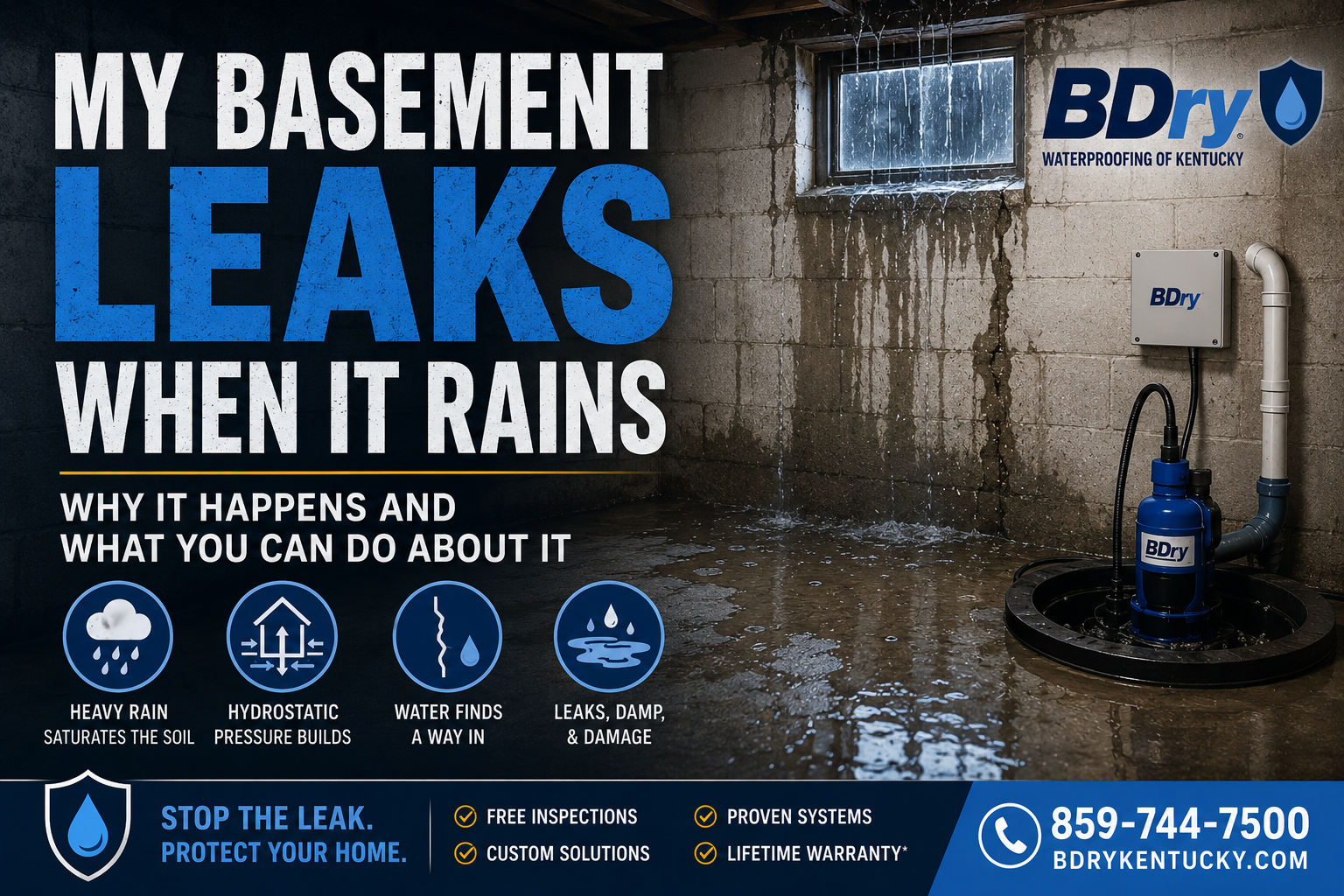
Why My Basement Leaks When It Rains
Rain doesn’t have to fall directly into your basement to create a leak.
When rain reaches the ground around your house, some runs across the surface while some enters the soil. As more water accumulates around your foundation, existing drainage systems may be unable to manage it effectively.
That’s when weaknesses and openings in the basement can become noticeable.
Water may enter through:
- Foundation wall cracks
- Floor cracks
- Mortar joints
- The joint between the wall and basement floor
- Areas around the foundation footing
- Porous foundation materials
- Basement windows or window wells
- Openings around utilities
The EPA specifically notes that water can enter homes through leaks or seep through basement floors. It also identifies improper grading and water flowing toward a house as potential causes of basement water problems.
In other words, that puddle on your basement floor could be the final symptom of a water-management problem occurring outside, underneath, or behind the basement walls.
Hydrostatic Pressure Could Be the Reason My Basement Leaks When It Rains
One term you’ll frequently encounter when researching “my basement leaks when it rains” is hydrostatic pressure.
After significant or prolonged rainfall, the soil around your foundation can become increasingly saturated. Groundwater around and beneath the foundation then needs somewhere to go.
Water naturally seeks available pathways, and even small cracks or openings can provide an entry point.
BDry explains that as the water table rises and an original builder-installed French drain becomes inadequate or fails, groundwater can build around the foundation and travel around the footing. The company’s high-capacity drainage system is designed to capture and manage this water.
That’s also one reason my basement leaks when it rains can suddenly appear during a particularly heavy storm even when your basement seemed dry during lighter rain.
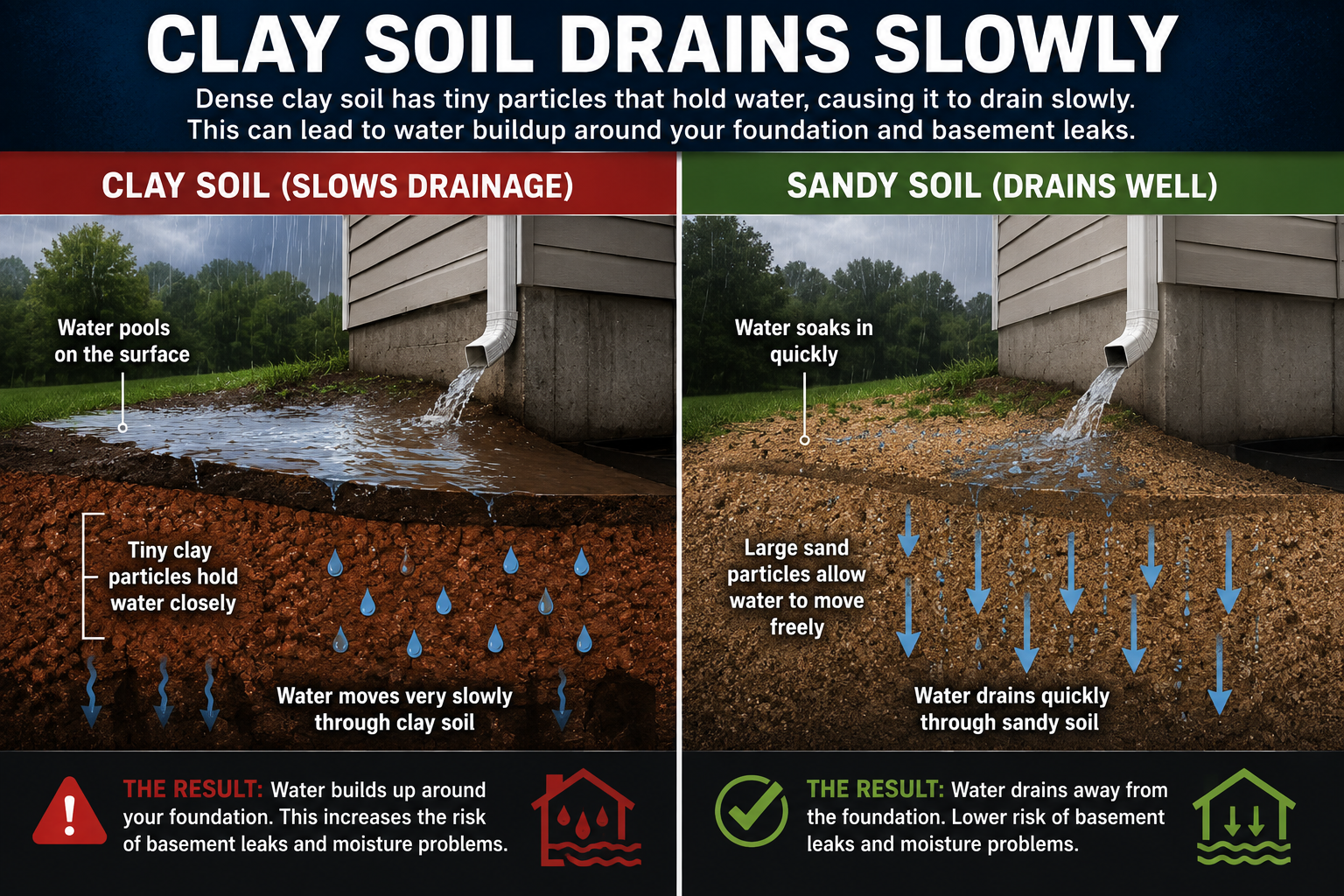
Kentucky Soil Can Make Drainage Especially Important
Kentucky homeowners should pay particular attention to the soil surrounding their foundations.
The University of Kentucky Cooperative Extension explains that dense clay soil drains slowly, which can increase surface runoff. University of Kentucky guidance on evaluating homesites also identifies shrink-swell characteristics as an important consideration in foundation and basement design.
That means proper water management around Kentucky homes is particularly important.
Periods of rain followed by drier weather can also change soil conditions around a foundation. Existing cracks or drainage weaknesses can become pathways for moisture when wet weather returns.
Foundation Cracks Can Allow Rainwater Into Your Basement
If you find yourself thinking, “my basement leaks when it rains, but only in one place,” look carefully at the nearby foundation wall.
Do you see a crack?
Concrete foundations can develop cracks for a variety of reasons. While not every crack means your foundation has a serious structural problem, a crack can provide a pathway for moisture.
You might notice:
- A thin vertical crack that becomes wet during storms
- Water stains beneath a crack
- Mineral deposits along the concrete
- Dripping or trickling water during heavy rain
- A damp area that repeatedly appears in exactly the same location
BDry’s waterproofing system incorporates engineered weep holes that allow certain water entering through wall cracks to be directed into its drainage system.
If a foundation issue requires structural stabilization or foundation repair, BDry refers homeowners to its affiliate, Ram Jack of Kentucky.
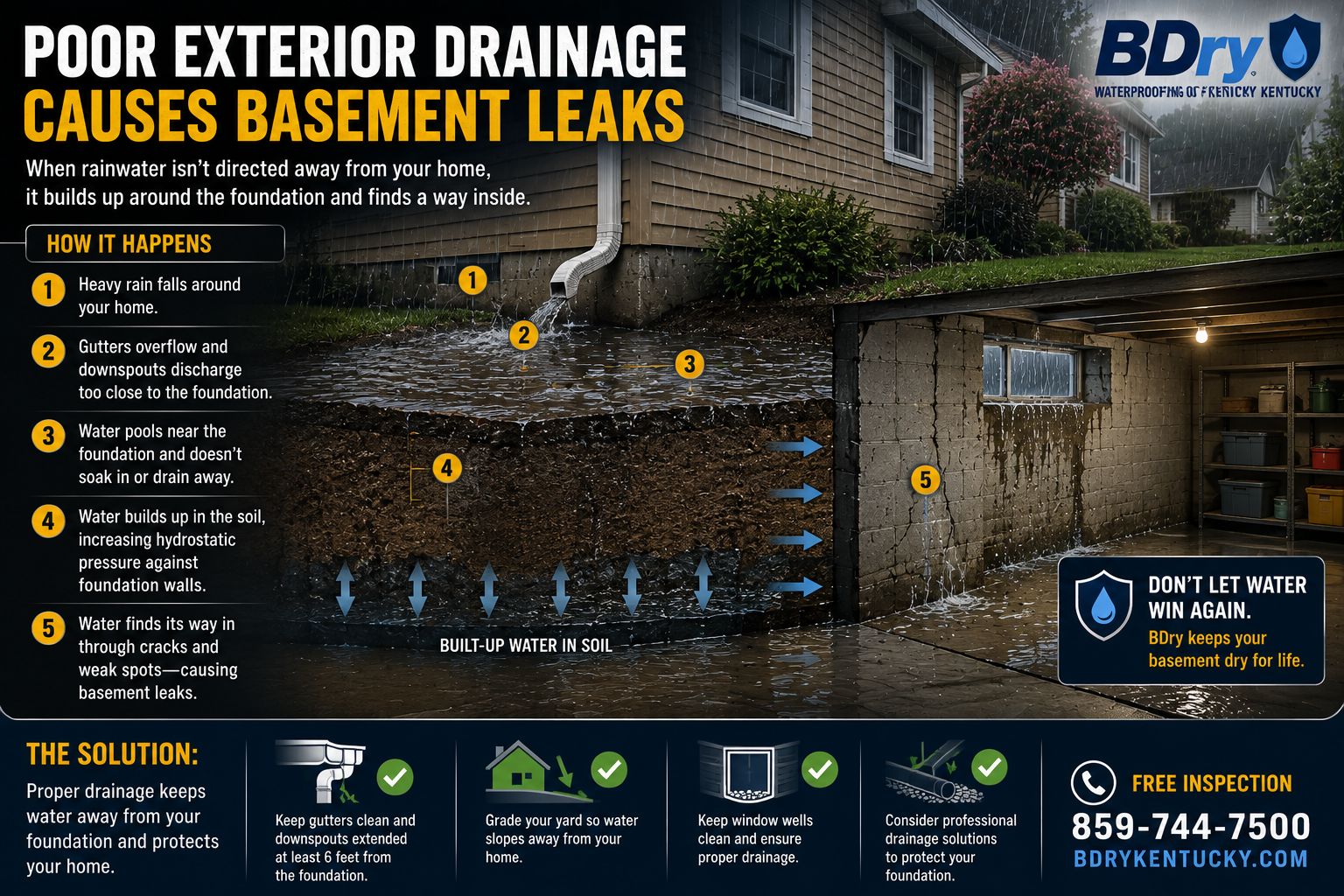
Poor Exterior Drainage Can Cause Basement Leaks
Sometimes the problem starts above ground.
Watch what happens around your house the next time my basement leaks when it rains.
Is water pouring over your gutters? Do downspouts empty immediately beside your foundation? Are there large puddles near the house? Does your yard slope toward your foundation instead of away from it?
Those seemingly simple problems can direct additional water toward your basement.
The EPA recommends maintaining gutters and ensuring the ground slopes away from a building’s foundation so water does not collect around it.
Good exterior water management can include:
- Keeping gutters clean
- Making sure downspouts discharge appropriately
- Correcting areas where water pools
- Maintaining proper grading
- Keeping window wells properly protected and drained
These steps can reduce the amount of rainwater accumulating around the foundation.
However, exterior drainage improvements won’t necessarily solve an existing groundwater or basement waterproofing problem. That’s why determining where the water is actually coming from is so important.
Why Does Water Appear Where the Basement Wall Meets the Floor?
This is an especially common and confusing basement leak.
Homeowners may assume the wall itself is leaking because they see a wet line along its bottom edge.
However, water can also travel around or beneath the foundation footing before appearing at the wall-floor joint.
BDry’s system is specifically designed to manage common groundwater entry paths around the foundation. Its high-capacity drain collects water while its wall system directs wall moisture toward the drainage system.
Instead of simply covering the visible wet area, professional waterproofing is intended to control where the water goes.
My Basement Leaks When It Rains Through the Windows
Don’t overlook basement windows.
Window wells can collect significant amounts of water during storms. If they aren’t draining effectively—or if exterior water is being directed toward them—water may eventually reach the window.
Look for:
- Water stains beneath basement windows
- Standing water inside window wells
- Failed seals
- Cracked window frames
- Soil or landscaping sloping toward the window
- Leaves or debris interfering with drainage
If my basement leaks when it rains consistently begins around a window during rainfall, the window and surrounding drainage should be included in the investigation.
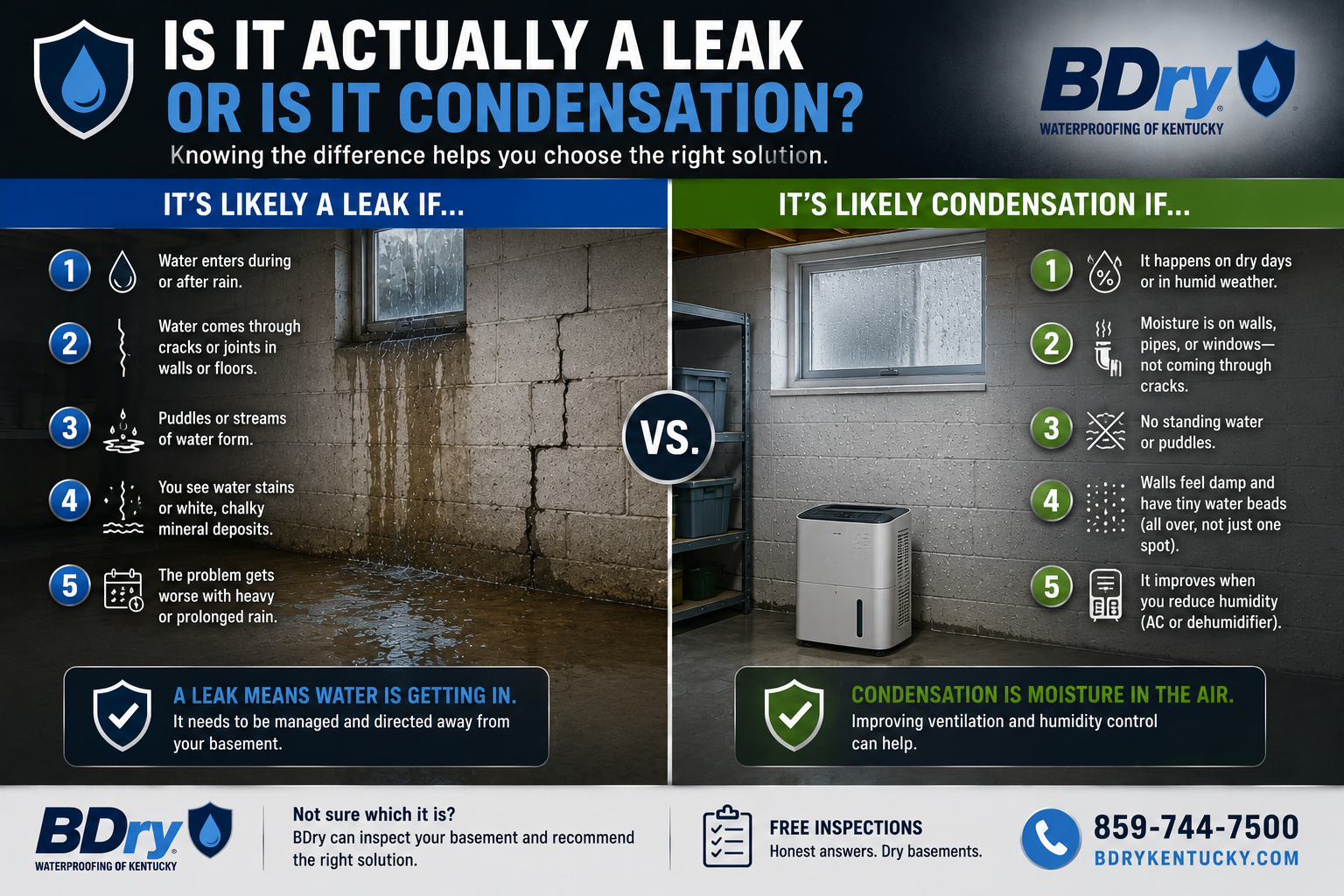
Is It Actually a Leak or Is It Condensation?
Here’s another possibility.
Not every wet basement wall is leaking.
Basements tend to be cooler than other parts of a house. Warm, humid air contacting cooler basement surfaces can create condensation.
The EPA explains that colder air holds less moisture, which is why moisture can condense on cold surfaces.
Condensation is more likely if you notice:
- General dampness rather than one defined leak
- Moisture across multiple surfaces
- Sweating pipes
- High indoor humidity
- Dampness even when it hasn’t recently rained
BDry offers commercial-grade dehumidifiers for basements and crawlspaces where excess humidity is part of the problem.
A professional evaluation can help distinguish between groundwater intrusion and excessive indoor humidity because they don’t necessarily require the same solution.
Why You Shouldn’t Ignore My Basement Leaks When It Rains
A little water after a storm might seem manageable.
You dry the floor, run a fan, and forget about it.
Then it rains again.
Repeated basement moisture can eventually affect drywall, flooring, insulation, wood, furniture, boxes, and other belongings stored downstairs.
Moisture also creates conditions favorable to mold growth. According to the EPA’s guide to mold and moisture, controlling moisture is the key to controlling mold, and the underlying water problem should be corrected when mold is present.
That’s why “my basement leaks when it rains” shouldn’t become something you simply accept as normal.
Why DIY Basement Waterproofing Often Isn’t the Solution
Once homeowners discover that my basement leaks when it rains, a trip to the hardware store can seem like the obvious next move.
Waterproofing paint. Caulk. Crack filler. Hydraulic cement.
Those products may have legitimate applications, but covering the place where water appears doesn’t necessarily address why water is reaching that location.
Imagine water is building up around your foundation and entering through a vulnerable area. Sealing the visible opening may not eliminate the groundwater surrounding the house.
The water still has to go somewhere.
Professional basement waterproofing takes a broader approach:
Where is the water coming from?
How is it reaching the foundation?
Where is it entering?
How can it be collected?
Where should that collected water go?
That’s considerably different from simply covering a damp spot.
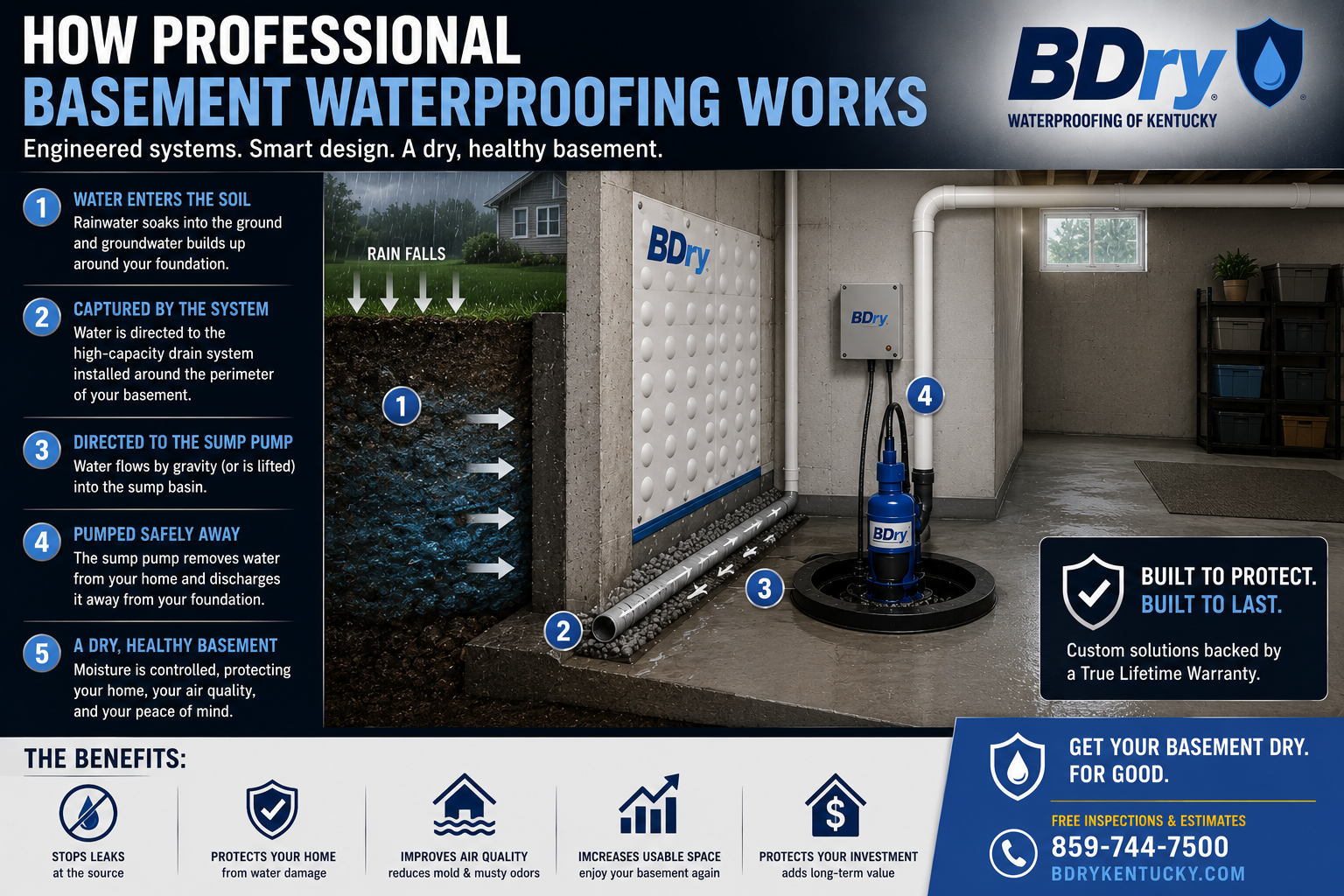
How Professional Basement Waterproofing Works
There isn’t one identical waterproofing solution for every Kentucky home.
BDry begins by evaluating the individual situation, such as “my basement leaks when it rains,” and selecting a solution appropriate for the property.
Depending on the conditions, a professional waterproofing solution can involve several components.
High-Capacity Drainage
BDry’s High-Capacity Drain System is designed to capture water at critical areas around the foundation and direct it toward an appropriate discharge point.
Wall Systems
If moisture enters through the foundation wall, BDry’s wall system helps direct it downward into the drainage system rather than allowing it to spread into the basement.
Sump Pump Systems
Some properties can’t effectively use gravity drainage because of factors such as terrain, foundation depth, or property layout.
In those situations, BDry may recommend a sump pump and basin to collect water and discharge it away from the foundation. BDry determines whether a sump pump is appropriate during its inspection process.
Humidity Control
When excessive humidity is contributing to basement dampness, a commercial-grade dehumidifier may also be recommended.
The goal isn’t to sell every homeowner exactly the same equipment. It’s to determine what’s causing the moisture and design a system around the home’s actual needs.
Why Kentucky Homeowners Choose BDry
If my basement leaks when it rains sounds like your situation, you don’t have to keep wondering what will happen during the next storm.
BDry has been in business for more than 60 years and provides basement and crawlspace waterproofing throughout Central, Southern, and Eastern Kentucky. The company uses patented waterproofing products and states that its team members are trained, licensed, and insured. BDry also backs qualifying installations with its lifetime warranty, subject to the warranty’s terms.
Homeowners can turn to BDry for:
- Basement waterproofing
- Crawlspace waterproofing
- Interior drainage systems
- Wall systems
- Sump pump solutions
- Moisture and humidity control
- Customized waterproofing solutions
- Free inspections and estimates
You can learn more about BDry’s basement and crawlspace waterproofing services.
Stop Saying “My Basement Leaks When It Rains” and Find Out Why
You shouldn’t have to check your basement every time rain appears in the forecast.
If you’re constantly saying, “my basement leaks when it rains,” the first step isn’t guessing which waterproof paint or sealant to buy. It’s determining why the water is entering your basement in the first place.
Whether the problem involves groundwater around the footing, foundation-wall seepage, inadequate drainage, a sump pump need, or excessive humidity, BDry can inspect the conditions and recommend an appropriate solution.
BDry of Kentucky offers free basement and crawlspace waterproofing estimates. You can schedule a free waterproofing quote with BDry or call 859-744-7500.
Don’t wait for another Kentucky rainstorm to find out how much worse the leak can become. Contact BDry today and take the first step toward a drier, more usable, and better-protected basement.
BDry will help you find solutions to your complaint “my basement leaks when it rains.”